

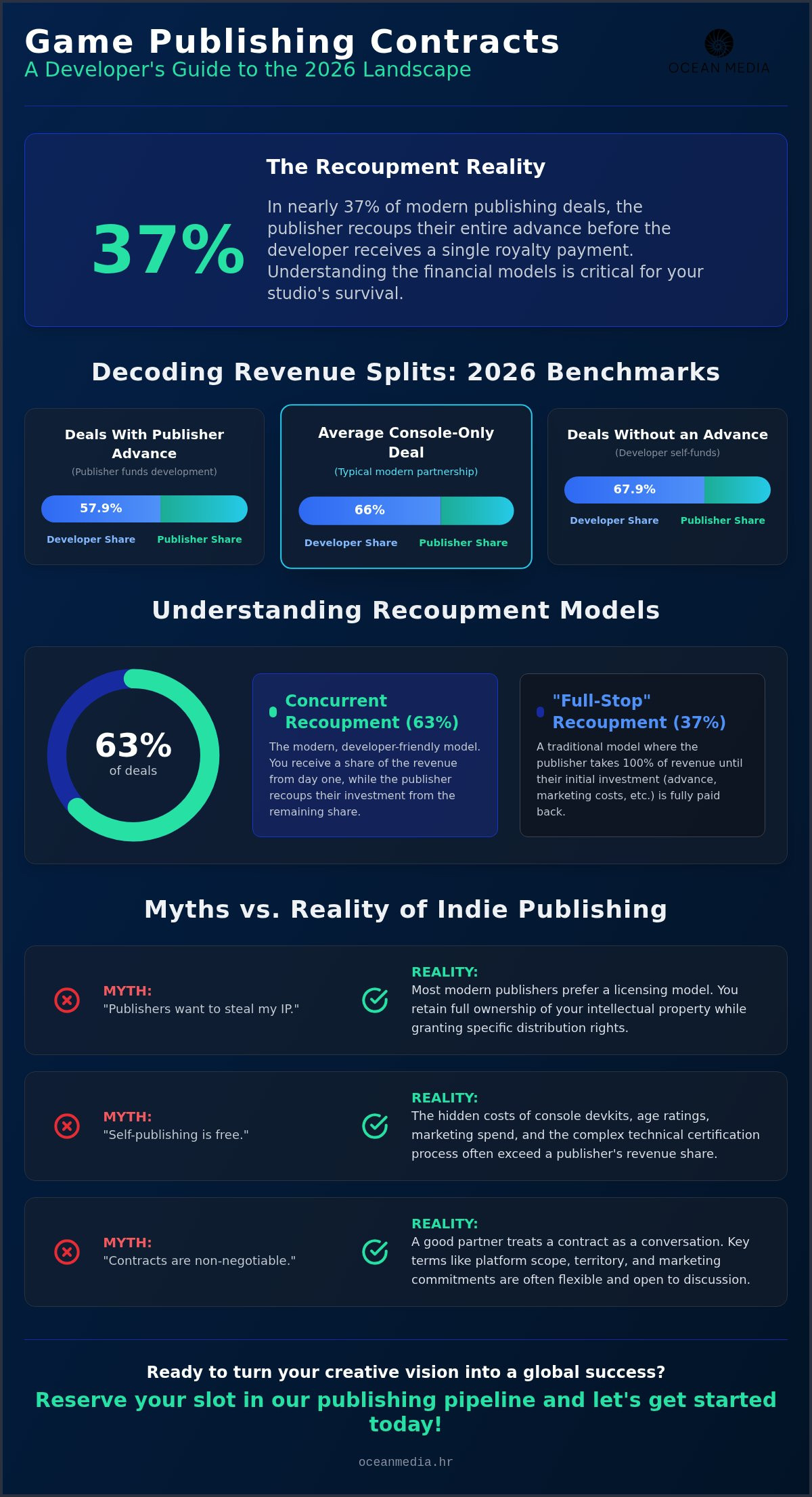
Did you know that in nearly 37% of modern publishing deals, the publisher fully recoups every cent of their advance before the developer sees a single royalty check? This stark reality makes understanding game publishing contracts the most critical skill you can develop as an indie creator in 2026. You've poured years into your project; the fear of losing your intellectual property or getting tangled in confusing revenue definitions is a heavy burden to carry. We understand that the transition from development to a professional console release feels like a daunting leap into the unknown.
Our guide empowers you to navigate these complex agreements with total confidence. We'll help you secure a partnership that protects your IP while maximizing your reach across all major platforms. You'll learn to decode common clauses, negotiate better terms, and find a partner who handles the grueling technical certification process for you. It's time to turn your creative vision into a global success. Reserve your slot in our publishing pipeline and let's get started today!
Key Takeaways
- Identify the 2026 revenue split benchmarks and recoupment models that determine how your studio actually gets paid.
- Protect your studio's future by understanding game publishing contracts, ensuring you retain ownership of your IP while granting specific platform rights.
- Define clear technical responsibilities for platform certification to avoid costly delays during the console submission process.
- Professional vetting and technical preparation are key; reserve your slot in our publishing pipeline and let's get started today!
Beyond the Legalese: Why Your Publishing Agreement Defines Your Studio’s Future
A game publishing contract is far more than a stack of dry legal papers. It is a bilateral agreement where you, the developer, grant specific rights to a partner in exchange for the funding, marketing, and distribution power needed to break through a saturated market. In 2026, the shift toward digital-only console storefronts has streamlined the publishing pipeline, making the speed of execution just as important as the code itself. Understanding game publishing contracts allows you to treat this document as a strategic blueprint rather than a hurdle.
Many developers start with a work-for-hire mindset, but a fair deal in 2026 is built on a collaborative partnership. You aren't just selling a product; you are aligning with a seasoned guide who understands what is a video game publisher in the modern era. This means moving beyond transactional thinking. A well-structured agreement reduces friction during the high-pressure console certification phase by clearly defining who manages technical bugs and who handles platform-specific administrative tasks.
The Core Purpose of the Agreement
The primary goal of any contract is to establish a clear scope of work. It defines the roadmap for bringing your game to consoles globally, ensuring no territory or platform is left behind. We believe in setting transparent expectations for communication and project management from day one. This clarity prevents the "ghosting" or "milestone creep" that can derail even the most promising indie projects. By formalizing these steps, we create a predictable path from your final build to a successful storefront launch.
Common Myths About Indie Publishing Deals
There are several misconceptions that often cause unnecessary anxiety for developers. Let's clear the air on three major points:
- Myth: Publishers want to steal your IP. In reality, most modern indie publishers prefer a licensing model. You retain your intellectual property while we handle the heavy lifting of distribution.
- Myth: Self-publishing is "free." While there's no royalty split, the hidden costs of devkits, marketing spend, and technical certification often exceed the cost of a partnership.
- Myth: Contracts are non-negotiable. Terms like territory and platform scope are often flexible. We view these as conversations, not ultimatums.
Securing a fair deal is the first step in protecting your studio's long-term health. If you are ready to move from development to distribution, reserve your slot in our publishing pipeline and let's get started today!
Decoding the Money: Revenue Splits, Recoupment, and Marketing Deductions
Revenue is the lifeblood of your studio. When understanding game publishing contracts, you must look past the headline numbers to see how the money actually flows. In 2026, benchmarks have shifted toward more developer-friendly terms. Recent data shows that developers in console-only publishing deals receive an average of 66% of the revenue. If your deal includes a publisher advance, that share typically sits around 57.9%, while deals without advances can reach 67.9%. Referencing a comprehensive Game Publisher Agreement Guide can help you visualize how these percentages translate into actual bank deposits.
We believe in transparency. It's not just about the split; it's about when that split starts. Many developers find themselves choosing between "full-stop" recoupment and "concurrent" models. You should also verify that the publisher has a contractual obligation to promote your title. A partner who is truly invested in your success will commit to a specific marketing effort rather than leaving it to chance. If you're ready to see how a fair financial structure works in practice, you can check out our developer partnership details to see how we align our goals with yours.
Understanding the Recoupment Process
The recoupment clause determines how a publisher recovers their initial investment. In 2026, roughly 37% of deals use a "full-stop" model where the publisher takes 100% of revenue until their costs are covered. However, 63% of the market has shifted to "concurrent" recoupment. In this scenario, you receive a smaller percentage of revenue from day one while the publisher recoups the rest. We recommend identifying "external expenses" clearly in the contract. Costs for localization and porting are standard, but you should always cap marketing spend. This prevents an "infinite recoupment" cycle where you never actually reach your royalty phase.
Defining Net Revenue
The definition of "Net Revenue" is perhaps the most important sentence in your entire contract. Platform holders like Sony, Microsoft, and Nintendo take a standard 30% cut of every sale. Your revenue split is calculated after these fees are removed. You must also account for returns, localized taxes, and storefront discounts. Net Revenue is the amount remaining after platform fees and pre-approved external costs are deducted. Ensuring this definition is narrow prevents a publisher from hiding overhead costs inside your royalty pool. Clear accounting is the foundation of a healthy partnership. To secure your studio's financial future, reserve your slot in our publishing pipeline and let's get started today!
Intellectual Property and Scope of Rights: Who Owns Your Game?
Your intellectual property (IP) is your studio's most valuable asset. When understanding game publishing contracts, the distinction between licensing and assignment is paramount. An assignment transfers ownership to the publisher; a license merely grants them permission to sell your game for a set period. We strongly advise developers to retain their IP ownership. Protecting your creative independence ensures that you, not the publisher, control the future of your characters, worlds, and mechanics. It's the difference between building a franchise and being a temporary tenant in your own house.
Territory and platform scope also require careful scrutiny. While digital storefronts are global, you must decide if you are granting worldwide rights or keeping specific regions for local partners. Similarly, you might want to limit the scope to specific consoles. This allows you to maintain flexibility if you decide to self-publish on PC or mobile later. Clear termination clauses are your safety net. If a partnership fails to meet performance milestones, a "reversion of rights" clause ensures the IP returns to you so your game doesn't vanish into legal limbo. We believe a contract should be a bridge to success, not a trap.
Protecting Your IP
A fair agreement is never perpetual. We recommend ensuring the license is time-bound, typically lasting between five and ten years. This period gives the publisher enough time to recoup their investment while giving you a clear exit strategy. Your contract should also explicitly define what happens to the game code and assets upon termination. You need guaranteed access to your source code to continue supporting your community or porting the title elsewhere. We pride ourselves on being a transparent indie game publishing partner, prioritizing the long-term health of your studio over short-term rights grabs.
Future Games and Exclusivity
Publishers often include a "Right of First Refusal" (ROFR) for sequels or franchise expansions. This gives them the right to match any offer you receive from another party for your next title. While common, ensure it doesn't become a "Right of First Negotiation" that drags on for months and stalls your momentum. Be wary of "competing games" clauses. These can prevent your studio from working on any title in the same genre for years, effectively paralyzing your creative team. A balanced deal allows you to explore new projects while we handle the complexities of the publishing pipeline. Exclusivity should be narrow and purposeful. If you want to keep your studio moving forward, reserve your slot in our publishing pipeline and let's get started today!
Platform Certification and Technical Obligations: The Console Reality
Certification is the final barrier between your development environment and the global market. While the financial split gets the most attention, the technical obligations in your agreement determine your actual launch date. Understanding game publishing contracts requires a deep dive into who carries the burden of platform compliance. Each platform holder has a rigorous set of standards, often referred to as TRCs (Sony), XRs (Microsoft), or Lot Check (Nintendo). Your contract must explicitly state who is responsible for fixing bugs that block these submissions. Typically, the developer handles game-breaking bugs, while a seasoned publisher manages the administrative back-and-forth with the platform holders.
Milestone schedules should always link payments or launch windows to successful platform approval. This ensures that both parties remain aligned on the technical health of the project. We also focus on global compliance, which includes securing age ratings from bodies like PEGI and the ESRB. These are not just checkboxes; they are contractual duties that can delay a release if handled incorrectly. Defining a clear "Bug Fixing" period for post-launch maintenance is equally vital to ensure your game remains playable as console firmware evolves. If you want to see how we handle these technical hurdles, you can explore our console publishing services for more detail.
Navigating Console Certification
Releasing a game on consoles involves a formal approval process that can be daunting for first-time studios. Ocean Media simplifies these console platform certification requirements by acting as your direct liaison with platform holders. In the contract, we define "Gold Master" as the final, release-ready build that has passed all internal QA and is ready for submission. We take the lead in managing communication with Sony, Microsoft, and Nintendo, allowing you to focus on the creative polish of your title. This collaborative approach reduces the risk of rejection and keeps your publishing pipeline moving toward a successful launch.
Submission and Storefront Management
The technical reality of a launch extends to metadata and storefront management. Your agreement should specify who writes the store descriptions, selects the tags, and uploads the localized assets. We manage the contractual timelines for "coming soon" pages and pre-order windows to build maximum momentum before the release date. Timing is everything in the digital landscape. For a closer look at how we synchronize these tasks, check our complete developer roadmap for launch timing. We provide a structured path that removes the guesswork from the submission process. To secure your spot on the digital shelf, reserve your slot in our publishing pipeline and let's get started today!
Securing Your Slot: Moving from Contract to Console Launch
Moving from a signed document to a live storefront requires a mix of legal diligence and technical readiness. While we've covered the mechanics of revenue and rights, the final step in understanding game publishing contracts is the vetting process. You should always have a legal professional review the final draft. Even when working with a collaborative partner, a lawyer ensures that the specific language matches the verbal agreements you've made. This isn't about a lack of trust; it's about professional clarity for both parties. A well-vetted contract is the bedrock of a long-term, successful relationship.
Preparing your technical documentation is the next priority. Platform holders require specific assets, from high-resolution icons to localized store descriptions. Having these ready prevents delays in the publishing pipeline. We've seen many studios stall at the finish line because they underestimated the administrative weight of a console launch. Our 20 years of industry experience allows us to anticipate these bottlenecks before they happen. This history provides you with a layer of security that newer entities simply can't offer. We've navigated two decades of platform shifts, and we use that knowledge to protect your interests while finalizing the deal and setting a realistic launch date.
The Ocean Media Partnership
We act as your seasoned guide through the complexities of the digital landscape. Our focus remains entirely on digital distribution, which means we don't carry the overhead or logistical delays associated with physical retail. This digital-only focus ensures a more direct and efficient path to console players. We prioritize administrative ease for small studios, taking over the heavy lifting of platform management so you can stay focused on your next creative breakthrough. Our goal is global reach, ensuring your game finds its audience on PlayStation, Xbox, and Nintendo Switch simultaneously.
Next Steps for Your Studio
The path to a successful launch starts with a conversation. Before you reach out, review your current build and prepare your pitch materials. We look for clear gameplay loops and a solid understanding of your target audience. Once you're ready, the transition from an indie project to a professional console release is straightforward. We provide the structure; you provide the vision. It's time to bring your game to the world. Contact us at oceanmedia.hr/developers/ to discuss your project and see how we can align our expertise with your goals. Don't let your game sit on a hard drive when it could be in the hands of players globally. Reserve your slot in our publishing pipeline and let's get started today!
Launch Your Creative Vision with Confidence
Success in the console market requires more than a great game; it demands a partnership built on transparency and technical precision. By prioritizing IP ownership and securing clear revenue definitions, you've already taken the first steps toward a sustainable studio future. Mastering the art of understanding game publishing contracts ensures that your hard work translates into a fair deal that respects your creativity while maximizing your global reach.
We're here to act as your seasoned guide through every stage of the process. With over 20 years of industry experience, our team specializes in managing the complex technical certification requirements for PlayStation, Xbox, and Nintendo Switch. We focus exclusively on global digital distribution to provide you with the most direct path to players. Let's turn your development milestones into a successful storefront presence. Reserve your slot in our publishing pipeline and let's get started today! Your journey from code to console is just beginning, and we're excited to help you navigate it.
Frequently Asked Questions
What is a 'standard' revenue split for indie game publishing in 2026?
In 2026, the average developer revenue share for console-only publishing deals is approximately 66%. If the deal includes an initial advance, that average shifts to 57.9%, while deals without advances often reach 67.9%. These figures are calculated after the platform holder takes their standard 30% cut. Understanding game publishing contracts requires knowing these benchmarks to ensure your studio remains financially healthy while leveraging our expertise.
Does a publisher own my game's intellectual property after I sign?
You should almost always retain your intellectual property ownership through a licensing model rather than an assignment. A standard agreement grants the publisher a license to distribute your game for a set period, typically five to ten years. This ensures that you control the future of your characters and world long after the initial launch. We prioritize protecting your creative independence as we help you navigate the publishing pipeline.
What happens if my game fails to pass console certification?
If a game fails certification, the contract's technical obligations clause determines who is responsible for the fixes. Developers typically handle game-breaking bugs that block launch, while we manage the administrative communication with Sony, Microsoft, or Nintendo. Our role is to act as your seasoned guide, using our expertise to minimize rejection risks. If you're ready for a structured path, reserve your slot in our publishing pipeline and let's get started today!
Can I terminate a publishing contract if the publisher isn't marketing the game?
Yes, you can usually terminate the contract if the publisher fails to meet specific marketing obligations or launch milestones. Most fair agreements include a termination clause for material breach, which includes a failure to promote the game as promised. It is vital to ensure these duties are explicitly written into the document. This protection prevents your game from being locked in a stagnant partnership where no growth occurs.
What are 'recoupable expenses' in a game contract?
Recoupable expenses are the pre-approved external costs that a publisher recovers before paying out your royalties. These typically include localization, technical porting, console devkits, and specific marketing spends. You should always insist on a cap for these deductions to avoid infinite recoupment cycles. Clear accounting ensures that both parties understand exactly when the revenue split shifts in your favor after the initial investment is recovered.
Should I sign a worldwide publishing deal or split it by region?
Most digital-only console deals are worldwide because storefronts like the PlayStation Store and Xbox Games Store are global by nature. However, you can negotiate regional splits if you have a specific partner for territories like Asia. For most indie studios, a worldwide deal simplifies the administrative burden and ensures consistent global reach. We manage these complexities so you can focus on making your game the best it can be.
What is a 'Right of First Refusal' clause?
A Right of First Refusal is a clause that gives your current publisher the opportunity to match any third-party offer you receive for a sequel. While common, you must ensure it doesn't turn into a Right of First Negotiation that stalls your studio's momentum. It should be a quick, time-bound process. This allows you to explore the market while giving your existing partner a fair chance to continue the franchise.
How long does a typical console publishing agreement last?
A typical console publishing agreement lasts between five and ten years. This duration gives the publisher enough time to recoup costs and manage the game's lifecycle through seasonal discounts and updates. After this period, the rights should revert to you unless both parties agree to an extension. It is a standard part of understanding game publishing contracts to ensure your studio isn't tied to a perpetual license that never ends.


