

Your game is ready for the world, but is your studio ready for the platform? Success on the PlayStation Store is often less about your creative code and more about your ability to master a mountain of administrative compliance. We understand that staring down the PlayStation developer program requirements can feel like facing a final boss (the kind with multiple phases) before you've even started the first level. You want to focus on gameplay, yet you're stuck worrying about opaque applications, high dev kit costs, and the looming threat of technical rejection.
It's a frustration we've helped many creators overcome throughout our 20+ years in the industry. We're going to simplify the transition from indie developer to professional partner by providing a clear checklist for bringing your game to consoles. We'll walk through the timeline from your initial application to the moment your store page goes live, giving you the confidence to manage the publishing pipeline. Our team acts as a bridge to the global market, removing the hurdles that stand in your way. To secure your future on the storefront, reserve your slot in our publishing pipeline and let's get started today!
Key Takeaways
- Move beyond hobbyist accounts by establishing a registered legal entity and preparing the necessary tax documentation for global distribution.
- Learn how to satisfy the PlayStation developer program requirements by mastering the TRCs, the essential technical "bible" for every studio.
- Understand the two-phase submission process, from crafting a professional pitch to signing the Global Developer Agreement.
- Discover how a seasoned partner helps you avoid common certification failures and accelerates your timeline for bringing your game to consoles.
- Focus on your creative vision while we manage the administrative hurdles; reserve your slot in our publishing pipeline and let's get started today!
Understanding the PlayStation Partners Ecosystem
The PlayStation Partners program serves as the exclusive gateway for bringing your game to consoles like the PS4 and PS5. Sony Interactive Entertainment (SIE) functions as a global gatekeeper, vetting every project to ensure it meets their rigorous standards for quality and stability. Unlike storefronts that allow almost any content, Sony's ecosystem is designed to protect the "PlayStation" brand by only hosting polished, professional experiences. This curated approach is why the application process is significantly more involved than most indies expect.
To satisfy the initial PlayStation developer program requirements, you must first understand the distinction between being a "Licensed Developer" and a "Partner." Many developers assume these are the same, but they represent different stages of the relationship. A Licensed Developer has cleared the basic corporate and legal hurdles to access documentation. A Partner, however, is a studio that SIE has officially greenlit to publish content on the store. Moving from one to the other requires a professional presence that goes beyond simple hobbyist development.
Why PlayStation is a "Walled Garden"
Sony's "walled garden" philosophy prioritizes a safe and consistent environment for its players. This isn't just about curation; it's a fundamental part of hardware security. By restricting access to their proprietary systems, Sony prevents exploits and ensures that every game runs as intended. Meeting the PlayStation developer program requirements involves proving that your studio respects this boundary. You'll typically need a "vertical slice," which is a playable, near-final representation of your core gameplay, to show SIE that your project is ready for the technical demands of their hardware.
The Benefits of Official Partnership
Once you've cleared the vetting process, the advantages are substantial. You get access to DevNet, which is the comprehensive repository for all PlayStation technical documentation. This includes proprietary SDKs that allow you to integrate features like the DualSense controller's haptic feedback or the PS5's high-speed SSD capabilities. Additionally, you can purchase specialized development and testing kits that are essential for final certification. Official partners also gain access to direct support channels, which are vital when troubleshooting technical bugs or store submission errors.
Navigating these tiers on your own can be daunting, but you don't have to do it alone. With over 20 years of experience, we've mastered the technical and administrative complexities of the PlayStation ecosystem. We're here to act as your seasoned guide through every stage of the process. If you're ready to see your vision on the big screen, reserve your slot in our publishing pipeline and let's get started today!
Administrative Requirements: Corporate and Legal Readiness
Before you think about hitting the "submit" button on the PlayStation Partners portal, your studio must present itself as a fully realized business. Sony doesn't enter into contracts with individual hobbyists. One of the most fundamental PlayStation developer program requirements is the existence of a registered legal entity, such as an LLC or a Corporation. This isn't just a formality; it's a prerequisite for signing the Global Developer Agreement (GDA), which is the document that governs your entire relationship with the platform.
Meeting the PlayStation developer program requirements also means having your technical infrastructure in order. Sony typically requires a Static IP address for your development environment. This allows their servers to whitelist your location, ensuring that proprietary data and SDK access remain within a controlled network. If you're working from a home connection with a rotating IP, you'll likely face immediate friction during the vetting process. Additionally, you'll need to prepare tax documentation early, such as W-8BEN forms for developers based outside the United States, to ensure smooth royalty payments later.
Legal Entity and Identity Verification
Identity verification goes beyond just showing a business license. You need to prove professional intent through a studio portfolio that showcases your team's capability and history. Sony also looks for alignment with global distribution standards. You should be prepared to link your corporate identity to age rating accounts like the ESRB or PEGI. This shows SIE that you're ready to handle the legal and ethical responsibilities of global content distribution.
Hardware Security and Office Requirements
The physical security of PlayStation Dev Kits is a non-negotiable priority for Sony. You must have a dedicated, lockable office space where these units are stored and used. Residential addresses are frequently flagged during the application process because they often lack the necessary security protocols to satisfy SIE auditors. If you're operating a remote team, you'll need to document exactly how you'll maintain hardware integrity and prevent unauthorized access to these sensitive devices.
Preparing these administrative foundations can take weeks of coordination and legal filing. We specialize in helping indies navigate these technical and administrative complexities so you can focus on your creative vision. If you're unsure if your current setup meets the mark, consulting with a seasoned guide can save you months of back-and-forth. Reserve your slot in our publishing pipeline and let's get started today!
Technical Requirements: Navigating TRCs and Certification
The Technical Requirement Checklist, or TRC, is the technical "bible" for anyone bringing their game to consoles. These aren't just helpful suggestions; they represent the core of the PlayStation developer program requirements that every studio must satisfy. If your build fails even one requirement, your submission will be rejected immediately. Common hurdles often include complex systems like Trophy implementation, handling controller disconnections across multiple players, and ensuring save-data integrity during unexpected power loss. Sony’s Functionality Quality Assurance (FQA) team acts as the final gatekeeper, testing these elements to ensure your game never compromises the console's operating system or the user's experience.
The TRC Roadmap
Success starts with understanding the critical technical pillars for PS5 titles. Beyond basic stability, Sony expects meaningful integration with modern hardware features. This includes the nuanced use of DualSense Haptic Feedback and the implementation of Activity Cards to help players jump directly into specific game modes. These features enhance the player experience but add layers of technical complexity to your build. To prepare, you should study console game QA testing requirements to identify potential failures before you even submit. This proactive approach is the only way to avoid the frustration of a "Red" report during your first review cycle.
The Certification Timeline
In 2026, the initial "Master Submission" review typically takes anywhere from several business days to two weeks, depending on the complexity of your title and current submission volumes. If your build fails, you'll receive a detailed report outlining the specific TRC violations. This initiates a resubmission loop that can quickly drain your resources and delay your launch. Managing a global release adds further complexity, as you must navigate console game age rating systems like ESRB, PEGI, and CERO simultaneously. Obtaining these ratings is a strict prerequisite for submission; without them, your publishing pipeline stops before it truly begins.
Navigating these technical waters requires more than just good code. It requires an intimate knowledge of the platform's expectations developed over years of submissions. With over 20 years of experience, we specialize in helping indies pass certification on the first try. We handle the technical and administrative complexities so you can focus on the art of game design. If you're ready to clear the final hurdles and see your game on the storefront, reserve your slot in our publishing pipeline and let's get started today!
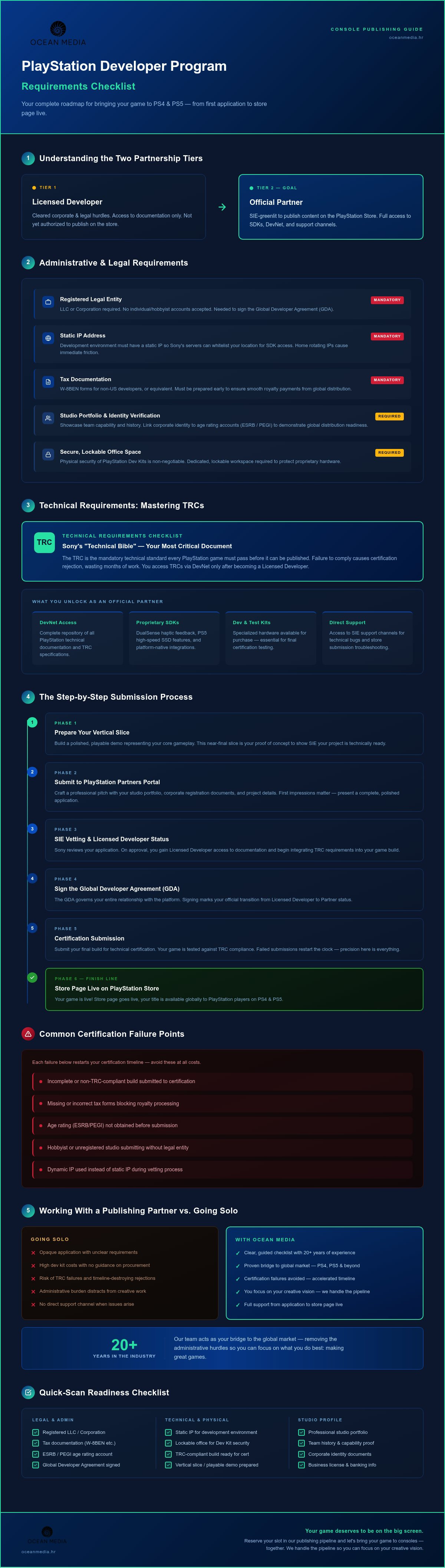
The Step-by-Step Submission Process
Meeting the PlayStation developer program requirements isn't a single hurdle; it's a multi-stage marathon that demands precision at every turn. The journey officially begins with Phase 1: your initial application via the PlayStation Partners portal. This is where you present your studio and your project to Sony’s vetting team. If your application passes their internal review, you'll move to Phase 2, which involves signing the Non-Disclosure Agreement (NDA) and the Global Developer Agreement (GDA). These legal documents are the foundation of your partnership, granting you access to proprietary tools and the DevNet environment.
Once the legal framework is set, you'll proceed to Phase 3: hardware procurement. This is where you order your physical development and testing kits. Following hardware setup, Phase 4 focuses on the administrative side of the storefront. You'll need to prepare all product metadata, including localized descriptions, age rating certificates, and store assets. Finally, you reach Phase 5: the "Gold" submission. This is the master build that undergoes the final, rigorous certification review to ensure your game is stable and compliant with all platform standards.
Crafting a Winning Pitch
Sony scouts look for professional intent in the "Project Description" field. Your pitch needs to be concise but comprehensive, proving that you have the technical capability and financial stability to bring your game to consoles. High-quality trailers and gameplay GIFs are essential; they provide immediate visual proof of your game’s quality. Your release timeline must also be realistic. If your schedule seems like a guess rather than a professional plan, it's a red flag that can stall your application before it even starts.
Hardware Logistics
After your GDA is signed, you can order your PS5 development hardware through the portal. Lead times for these units vary, so it's vital to order them as soon as you're cleared. You'll need both Dev Kits, which are used for active coding and debugging, and Test Kits, which allow you to see how the game performs in a retail-like environment. Managing these kits involves regular firmware updates and the use of proprietary DevNet tools. Keeping your hardware synced with Sony’s latest standards is a critical part of the technical pipeline.
Navigating these five phases while managing a development team is a massive undertaking. We’ve spent over 20 years helping studios streamline this process, ensuring that administrative delays don't kill your momentum. We handle the technical and administrative complexities of the storefront setup so you can focus on the game itself. To secure your place on the PlayStation Store, reserve your slot in our publishing pipeline and let's get started today!
Accelerate Your Launch: Working with a Publishing Partner
While the path to self-publishing is technically open, the administrative friction often blindsides indie teams. Managing the PlayStation developer program requirements on your own means becoming a part-time lawyer and a full-time bureaucrat. By partnering with an established publisher, you bypass these hurdles entirely. You leverage our existing legal and tax frameworks, allowing you to skip the months of back-and-forth often required for identity and entity verification. We take on the burden of corporate compliance so your team can stay focused on the code.
Technical compliance is another area where a partner provides a massive advantage. We use data from years of common console certification failures to ensure your build passes on the first attempt. This isn't just about following a checklist; it's about understanding the unwritten expectations of the certification teams. Additionally, we manage your global storefront presence across the Americas, Europe, and Asia simultaneously. We handle the localized metadata and region-specific ratings so your game reaches the widest possible audience without you ever leaving your development environment.
Why Ocean Media is Your Ideal Guide
With over 20 years of experience, we've refined the process of bringing your game to consoles into a predictable science. We take the "seasoned guide" role seriously, acting as the bridge between your creative vision and the global market. Our expertise in technical and administrative platform submissions means we handle the bureaucracy that often stalls indie projects. This allows your team to maintain momentum and focus on the final polish that players expect from a PlayStation title.
Get Started Today
The transition from indie developer to professional console studio is easier when you aren't walking the path alone. Don't let paperwork or technical rejection stall your creative vision. We've built a structured path for you to follow, removing the uncertainty from the publishing pipeline. To secure your future on the PlayStation Store, reserve your slot in our publishing pipeline and let's get started today!
Launch Your Vision on the Global Stage
The journey to bringing your game to consoles is defined by how you handle the administrative hurdles long before the launch date. We've explored the essential legal structures, technical checklists, and the multi-phase submission process required for a professional release. Fulfilling the PlayStation developer program requirements demands precise attention to detail; however, you don't have to navigate this complex landscape alone. Our team acts as a bridge between your creative vision and the global market.
With over 20 years of experience in global digital distribution and specialized expertise in navigating SIE certification, we manage the technical and administrative complexities for you. It's time to stop letting bureaucracy stall your progress and start seeing your game on millions of screens worldwide. We've built a structured path to ensure your project clears every hurdle on the first try. Reserve your slot in our publishing pipeline and let's get started today! We're excited to help you reach your audience and achieve lasting success.
Frequently Asked Questions
Do I need to be a registered company to publish on PlayStation?
Yes, you must have a registered legal entity like an LLC or Corporation to sign the Global Developer Agreement. Sony Interactive Entertainment doesn't offer "individual" or hobbyist accounts for publishing. This business structure ensures you can handle the legal and tax obligations associated with global distribution. If you haven't established your company yet, reserve your slot in our publishing pipeline and let's get started today!
How much does it cost to join the PlayStation Developer Program?
Joining the partner program itself doesn't typically involve an upfront registration fee. However, fulfilling the PlayStation developer program requirements involves significant costs for legal entity formation and purchasing specialized development hardware. You'll also need to budget for age ratings and technical QA. We help indies manage these administrative and technical complexities efficiently to avoid wasting resources on failed submission attempts while bringing your game to consoles.
Can I use a residential address for my PlayStation developer application?
Sony generally flags residential addresses during the application process because they prioritize hardware security. You're required to have a dedicated, lockable office space where development kits can be stored safely. If you operate a remote team, you'll need to demonstrate robust security protocols to satisfy SIE auditors. This physical security requirement is a common hurdle that we help our partners navigate successfully through our established publishing pipeline.
What is a TRC and why is it so important for certification?
A TRC, or Technical Requirement Checklist, is the mandatory set of rules your game must follow to pass certification. These requirements cover everything from how your game handles controller disconnections to the integrity of save data during power loss. Failing even one TRC will result in an immediate rejection. Mastering these technical pillars is essential for any studio bringing their game to consoles in 2026 to ensure platform stability.
How long does the PlayStation certification process take in 2026?
The initial "Master Submission" review typically takes between several business days and two weeks. This timeline can fluctuate based on current submission volumes and the technical complexity of your title. If your build fails, the resubmission loop can add weeks to your schedule. We leverage our 20+ years of experience to help you pass on the first try, keeping your launch on track and your studio moving forward.
Does Sony provide free dev kits to indie developers?
Sony typically requires developers to purchase their own development and testing hardware after signing the Global Developer Agreement. While some specialized loan programs exist for high-profile projects, most indies should plan for this as a necessary investment. These kits are essential for debugging and ensuring your game meets all TRCs before the final submission. We help you manage these hardware logistics as part of our professional publishing pipeline.
Can I self-publish on PlayStation without a third-party publisher?
Yes, you can self-publish if you meet all the PlayStation developer program requirements and pass the rigorous vetting process. However, many indies find the administrative and technical hurdles overwhelming. Managing legal entities, tax documentation, and the TRC checklist requires significant time and expertise. Partnering with us allows you to bypass this bureaucracy and focus entirely on your game's creative development while we handle the complex storefront logistics.
What happens if my game fails the PlayStation certification review?
If your build fails, you'll receive a detailed "Red" report outlining every TRC violation detected by the FQA team. You must fix these issues and resubmit the build for another full review. This cycle can be costly and delay your launch significantly. To avoid this, reserve your slot in our publishing pipeline and let's get started today so we can help you pass certification with total confidence!


