

The dream of seeing your game on a retail shelf often turns into a financial nightmare of manufacturing costs and unsold inventory. While the nostalgia of a physical box is tempting, the reality of the 2026 market is that digital-first strategies offer the only sustainable path to global success. Understanding why digital game publishing beats physical for indie developers is no longer just a trend; it's a survival requirement for studios looking to scale without the crushing weight of upfront logistics.
We know that you've poured years of passion into your project and the thought of complex console certification or limited retail reach feels like a massive wall. With over 20 years of experience in the publishing pipeline, we've helped many creators overcome these hurdles. Discover why a digital-first strategy is the superior choice for indie studios in 2026 and how to navigate the publishing pipeline for global console success. We'll explore a clear framework for bringing your game to consoles globally without the risks of traditional manufacturing. If you're ready to secure your studio's future, reserve your slot in our publishing pipeline and let's get started today!
Key Takeaways
- Analyze the financial shift from physical manufacturing to digital storefronts to maximize your studio's return on investment.
- Identify how to transition from traditional retail shelf space to high-visibility algorithmic featuring on major console platforms.
- Explore the strategic reasons why digital game publishing beats physical for indie developers in a market that prioritizes immediate global accessibility.
- Follow a structured checklist for bringing your game to consoles while navigating technical certification and age rating requirements.
- Find out how to streamline your path to PlayStation, Xbox, and Switch; reserve your slot in our publishing pipeline and let's get started today!
The 2026 Console Landscape: Why Digital-First is the Indie Default
The console market has undergone a fundamental transformation where the digital storefront is now the primary engine for player discovery. In 2026, the traditional retail shelf has been replaced by sophisticated algorithms and curated featuring spots on PlayStation, Xbox, and Nintendo Switch. High-performing studios no longer wait for a retail buyer's approval to reach their audience. Instead, they leverage immediate visibility to connect with millions of players worldwide. This accessibility is a core reason why digital game publishing beats physical for indie developers; it removes traditional gatekeepers and puts your creative vision directly in the hands of the community.
Global Reach Without Geographical Barriers
Physical distribution is often tethered to regional logistics, customs delays, and the high risk of unsold stock sitting in a warehouse. Digital distribution shatters these boundaries. By focusing on a digital-first strategy, you can launch simultaneously in Tokyo, London, and New York without printing a single disc or signing a shipping contract. Success in the modern market requires more than just availability; it requires indie game localization to truly resonate with diverse cultures. This approach allows you to target niche global communities that physical retail simply cannot reach efficiently or affordably. You gain the power to scale your presence based on real-time demand rather than manufacturing guesses.
The Flexibility of Post-Launch Support
Digital builds are living products that can evolve alongside your player base. In the fast-moving 2026 tech cycle, the ability to deploy a "Day One" patch or an emergency hotfix is a massive strategic advantage. Physical media is static. If a critical bug is discovered after the discs are pressed, your studio's reputation is at risk before the first player even hits "Start." Digital publishing allows for iterative development where player feedback shapes the game's evolution through seamless updates. This resilience ensures your project remains compatible with evolving console firmware and hardware revisions without the need for expensive product recalls.
Managing these technical certification hurdles and administrative complexities requires a console game publishing partner with deep industry roots. We act as your professional guide, bringing 20+ years of experience to the table to ensure your release is optimized for maximum impact. Our collaborative approach simplifies the transition from development to a successful global launch. If you are ready to bring your game to consoles with a proven strategy, reserve your slot in our publishing pipeline and let's get started today!
Digital vs Physical Publishing: A Cost and ROI Comparison
Choosing between a physical release and a digital-first approach is a decision that defines your studio's financial health. While the idea of a boxed copy is nostalgic, the math rarely favors the independent creator. Physical publishing requires navigating Minimum Order Quantities (MOQs), where you must pay for thousands of units upfront before a single sale occurs. If those units don't move, your capital is trapped in a warehouse. This financial risk is a primary reason why digital game publishing beats physical for indie developers who need to keep their budgets lean and agile.
The High Financial Barrier of Physical Manufacturing
The capital-intensive nature of physical media often drains development funds that should be spent on polish or marketing. Beyond the initial printing, you face hidden fees like storage costs, returns from retailers, and price protection risks. If a retailer decides to discount your game to clear shelf space, you might be on the hook for the margin difference. Digital models eliminate these variables entirely. By removing the need for physical logistics, you protect your runway and ensure that every dollar spent goes toward improving the player experience.
Maximizing ROI with Digital Storefront Efficiency
Digital storefronts offer a much cleaner revenue split. You typically keep a significantly higher percentage of each sale compared to the thin margins left after retailers, distributors, and manufacturers take their cuts. This efficiency makes a global console launch accessible to studios of all sizes. You can leverage flexible pricing and seasonal sales events to drive long-tail revenue without worrying about physical inventory levels. This transparency is another reason why digital game publishing beats physical for indie developers seeking predictable cash flow.
Speed is your greatest asset in a competitive market. The digital publishing pipeline allows you to bypass the months of lead time required for manufacturing and shipping. You can move from a finished build to a live storefront in a fraction of the time, allowing your marketing momentum to translate directly into sales. We've spent two decades refining this process to ensure your project reaches its full potential without unnecessary delays. If you're ready to maximize your returns and minimize your risk, reserve your slot in our publishing pipeline and let's get started today!
The 2026 Distribution Strategy Checklist for Indie Studios
Moving from financial theory to actual execution requires a structured commercial framework. In 2026, you can't rely on gut feelings or nostalgia for "boxed copies" to drive your studio's growth. You need a strategy that protects your longevity and ensures your development runway remains intact. This decision-making process starts with a realistic assessment of your resources and market goals. It's the most practical way to see why digital game publishing beats physical for indie developers who want to scale without the weight of unsold inventory.
Before committing to a distribution path, run through this essential checklist. Do you have the liquid capital for a physical run without jeopardizing your final months of development? Most indies find that MOQs (Minimum Order Quantities) drain their marketing budgets at the worst possible time. Does your genre, such as a niche RPG or a rhythm game, strictly demand a physical collector's edition to satisfy a core fanbase? If the answer is no, the overhead of physical retail is likely a distraction. Finally, are you prepared for the technical console platform certification requirements? Handling these alone often leads to launch delays that a digital-first strategy avoids.
Assessing Your Studio’s Internal Capabilities
Your team is built for creativity, not administrative paperwork. Managing storefront submissions and age rating certifications is a full-time marathon that can pull your lead developers away from critical bug fixing. This is why digital game publishing beats physical for indie developers; it allows for a cleaner division of labor. By outsourcing the technical and administrative hurdles of bringing your game to consoles, you ensure that your team stays focused on game quality while we navigate the submission maze for you. We act as your seasoned guide through every step of the process.
Market Readiness and Global Scaling
Digital penetration is at an all-time high in 2026, making it the most efficient way to test market readiness. You can target regions with high digital adoption rates without the logistical nightmare of international shipping or customs. A "Digital First, Physical Later" model is a smart, low-risk growth strategy that many successful studios now follow. It allows you to prove the market and build a community before you ever touch a physical disc. This approach aligns your distribution with your marketing efforts, ensuring a cohesive launch that reaches players exactly where they are. If you're ready to secure your place on the global stage, reserve your slot in our publishing pipeline and let's get started today!
How to Vet a Console Game Publishing Partner for Digital Success
Selecting a partner to handle your console release is one of the most critical business decisions you'll make. It isn't just about finding someone to host a file; it's about finding an ally who understands the intricate machinery of digital storefronts. This specialized focus is another reason why digital game publishing beats physical for indie developers. While physical distributors are often bogged down by inventory logistics, a digital-first partner focuses entirely on visibility and platform relationships. You need a guide with a proven track record, ideally with 20+ years of history in the publishing pipeline, to navigate these waters effectively.
A true partner should be collaborative and approachable. You don't want a cold, transactional relationship when you're facing tight deadlines or technical bugs. Look for a team that has a direct line to PlayStation, Xbox, and Nintendo. These relationships are forged over decades and can be the difference between your game getting lost in the noise or being highlighted on the front page. Your partner should act as a bridge between your creative vision and the global market, ensuring that your project receives the attention it deserves.
Navigating Technical Certification and Administrative Hurdles
Certification is often a "black box" for developers, and it's the primary reason indie games suffer from last-minute delays. The requirements are strict. A single failed check can push your launch back by weeks, killing your marketing momentum. A seasoned partner manages this "boring" administrative work, including age ratings and platform-specific submissions, on your behalf. This allows your team to focus on what they do best: writing code and refining gameplay. By leveraging professional expertise, you ensure a smooth, global digital launch that honors your hard work and meets every technical milestone.
Analyzing Global Reach and Storefront Visibility
Visibility is the currency of the digital age. A seasoned console game publishing partner knows how to improve your storefront featuring potential through strategic timing and regional price optimization. They understand how to tailor your presence across multiple digital platforms simultaneously to capture different audience segments. This global storefront expertise is why digital game publishing beats physical for indie developers who want to maximize their reach without the overhead of physical shipping. If you're ready to see your game thrive on the global stage, reserve your slot in our publishing pipeline and let's get started today!
Streamlining Your Launch: The Digital Publishing Pipeline
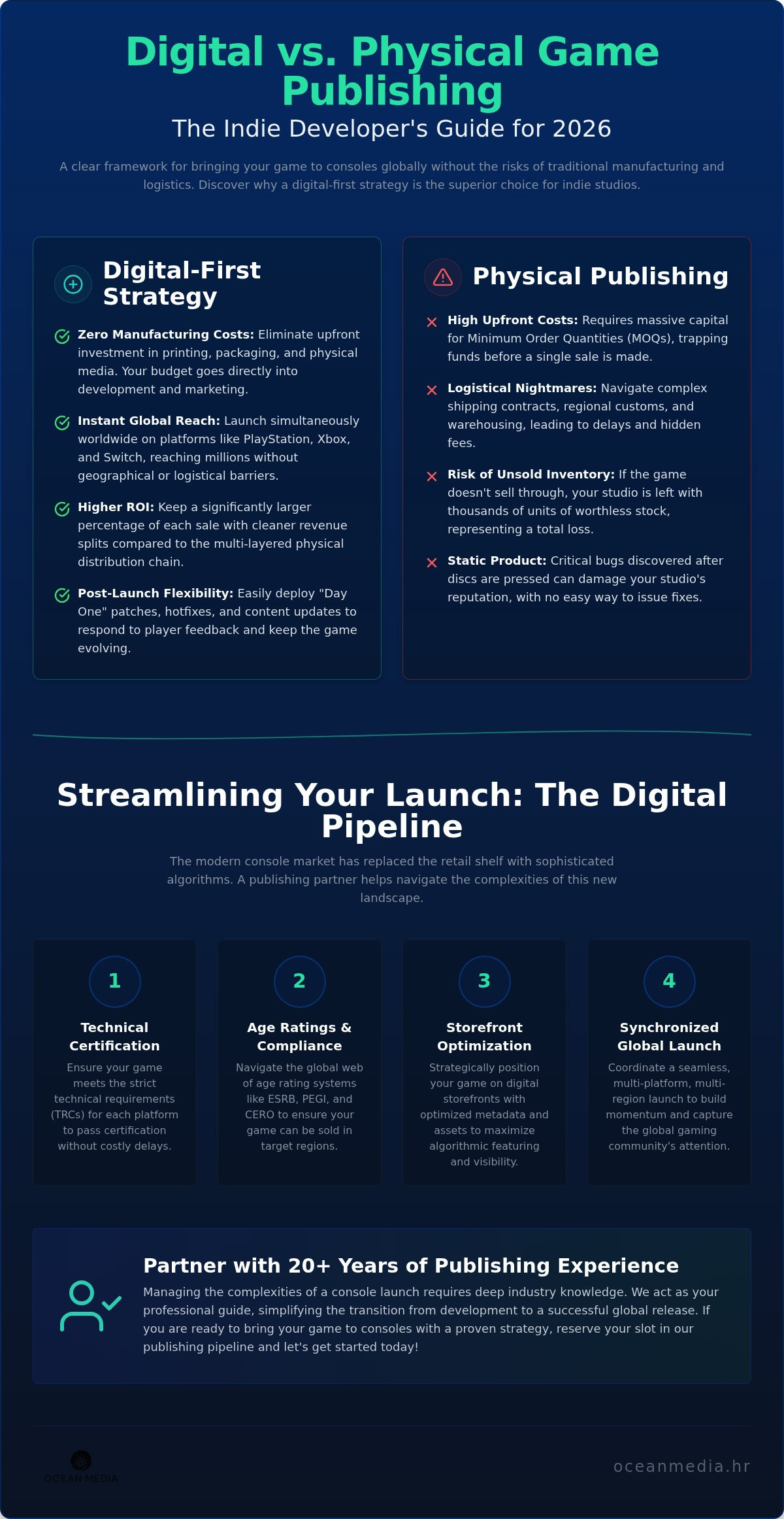
The choice is clear for studios looking to thrive in a competitive market. Digital-first publishing provides the scalability, safety, and efficiency required to turn a creative project into a global commercial success. It eliminates the logistical bottlenecks that often stall smaller teams. This streamlined approach is exactly why digital game publishing beats physical for indie developers in 2026. You gain the freedom to iterate on your build and respond to player feedback without being anchored to a static physical product. It's about protecting your studio's runway while maximizing your potential for long-tail revenue.
The Ocean Media Advantage
We act as your seasoned guide through every stage of the publishing pipeline. With 20+ years of industry experience, we've seen the console landscape evolve from its infancy to the digital powerhouse it is today. Our approach is deeply collaborative (and purposefully transparent), ensuring you're never left in the dark during the submission process. We specialize in digital console storefronts, handling the technical certification hurdles that often catch developers off guard. By partnering with us, you're not just hiring a publisher; you're gaining an ally committed to bringing your game to consoles with professional precision. We simplify the transition so your team stays focused on the next big update.
Your Next Steps for Console Success
Transitioning from a completed game to a live store page requires careful planning and a deep understanding of platform requirements. You must prepare your build for the rigorous digital certification process while aligning your launch window with current storefront trends and featuring opportunities. Don't let administrative complexities or regional age rating filings distract you from your creative vision. We manage the "heavy lifting" of platform submissions and administrative paperwork so your team can focus on polishing the core gameplay experience.
The path to a successful console release is structured, proven, and accessible. We've refined our methods over two decades to make the process as seamless as possible for our creative partners across PlayStation, Xbox, and Nintendo Switch. If you're ready to secure your studio's future and reach a global audience, contact Ocean Media to start your publishing journey. There's no reason to let logistical fears or manufacturing risks hold your project back. The infrastructure for your global success is already in place. Simply reserve your slot in our publishing pipeline and let's get started today!
Securing Your Studio's Future on the Global Stage
Transitioning to a digital-first strategy is more than a cost-saving measure; it's a commitment to your studio's long-term sustainability. By removing high upfront manufacturing costs and the risk of unsold inventory, you protect your development runway and focus resources where they matter most. This financial agility is a core reason why digital game publishing beats physical for indie developers aiming for a successful launch across PlayStation, Xbox, and Nintendo Switch. You gain immediate global reach and the flexibility to iterate based on real-time player feedback.
Our team brings 20+ years of industry experience to your project, specializing strictly in digital distribution. We navigate the technical certification hurdles and administrative complexities that often stall independent creators. We're here to act as your collaborative partner, ensuring your creative vision reaches the global market with professional precision. Success is within reach when you have a guide who understands the modern publishing pipeline. To secure your future on the world's leading platforms, reserve your slot in our publishing pipeline and let's get started today!
Frequently Asked Questions
Is it better to publish an indie game digitally or physically in 2026?
Digital publishing is the superior choice for most indie studios because it offers immediate global accessibility without the crushing weight of manufacturing costs. This is a primary reason why digital game publishing beats physical for indie developers who'll need to remain agile and financially stable. By focusing on a digital-first strategy, you avoid the logistical nightmares of international shipping while maximizing your potential for long-tail revenue through storefront featuring.
What are the upfront costs for physical game publishing compared to digital?
Physical publishing requires significant upfront capital to cover manufacturing and Minimum Order Quantities (MOQs). These costs can drain an indie budget before the game even launches. In contrast, digital setup costs are minimal and focused on administrative and technical preparation. This difference in barrier to entry allows you to allocate more resources toward game polish and marketing, ensuring your project has the best possible chance for success on major console platforms.
How long does the digital console certification process usually take?
The digital console certification process typically takes several weeks, though this timeline depends on the complexity of your build and the specific platform requirements of PlayStation, Xbox, or Nintendo. Technical hurdles or failed certification checks can cause significant delays if not managed correctly. Our team leverages over 20 years of experience to navigate these administrative complexities, helping you stay on track for your target launch window without unnecessary setbacks.
Can an indie game get a physical release after a successful digital launch?
Yes, many successful indie titles transition to a physical release after proving their market value digitally. This model's a low-risk way to satisfy collector demand without jeopardizing your studio's initial financial health. While Ocean Media focuses strictly on digital distribution, we believe this sequence is the safest path to growth. It's an approach that allows you to build a community and secure revenue before committing to the high costs of physical production.
What percentage do console storefronts take from digital sales in 2026?
Most major console storefronts continue to follow a 70/30 revenue split, where the platform takes 30% of digital sales. Some platforms have introduced tiered structures or incentives, but the 30% margin remains the industry standard. This transparent split is part of why digital game publishing beats physical for indie developers, as physical retail margins are often much thinner after distributors, manufacturers, and retailers take their respective cuts of the final price.
Do I need a publisher for a digital console release if I can self-publish?
While self-publishing is possible, a seasoned partner provides the technical depth needed to navigate the black box of console certification. Managing age ratings, administrative submissions, and platform-specific requirements is a full-time commitment that can distract your team from development. We act as your expert guide, handling these complexities so you can focus on your creative vision. To simplify your launch, reserve your slot in our publishing pipeline and let's get started today!
What is the biggest risk in physical game distribution for small studios?
The biggest risk in physical distribution is the drain on your liquid capital caused by unsold inventory and storage fees. If your physical stock doesn't move, your investment is effectively trapped in a warehouse. Small studios often can't afford this level of financial exposure. Digital-only models eliminate these inventory risks entirely, allowing for a safer and more scalable global launch strategy that adapts to real-time player demand without the burden of physical logistics.
How do I choose the right console game publishing partner for my game?
Look for a partner with a proven track record and a collaborative, approachable spirit. Experience matters; we suggest finding a team with at least 20 years of history in the publishing pipeline to ensure they have a direct line to platform holders. Your partner should handle the technical certification and administrative hurdles while maintaining a focus on your success. If you're ready to start bringing your game to consoles with a reliable guide, reach out to us today.


